One correct combined picture — from books that don't agree.
Multi-entity close and consolidation for groups of 2–50 entities. Built for structures that are multi-entity by mandate — a propco and an opco, a holding company over sixteen property LLCs, a sponsor carrying one entity per asset.
Start an evaluation See how it works
US GAAP and IFRS as a configuration switch. Single currency.
Your “consolidated” report is a roll-up.
Nothing eliminated. Intercompany still sitting in every line. Revenue counted twice where one entity sold to another. The combined number in the board deck is wrong — and everyone quietly knows it.
What a roll-up structurally leaves in
Both sides of every sale
Intercompany revenue and the matching cost of sales, counted once in each entity — group revenue overstated by the full intragroup amount.
Both sides of every balance
The seller's receivable and the buyer's payable, on two balance sheets — assets and liabilities each grossed up by the same figure.
Profit on assets still held
Margin recognized on stock or property that never left the group, sitting in earnings and in the carrying value of what's still on hand.
Nothing is built for the middle.
Spreadsheets
Two entities already need eliminating, and a spreadsheet will do it. What it will not do is show its work — how the figure was derived, who checked it, or what happens the month the person who built the tab is out.
Enterprise suites
Scoped and priced for groups far larger than yours — often six-figure implementations to solve a problem you can describe in one sentence.
Everything else
Assumes one clean ERP. Real groups run NetSuite at the top, QuickBooks per property, and a spreadsheet for the entity nobody wants to migrate.
loam is built for mixed-source groups specifically — a trial-balance file from every entity, whatever system it came from, matched and eliminated on one consistent basis.
Trial balances in. A close you can defend out.
Load
A trial-balance file from every entity, whatever system it came from.
Match
Paired by counterparty; variances surfaced, aged where aging is provided.
Eliminate
Intercompany rent, fees and balances — plus profit on assets and stock transferred between affiliates. Deferred tax only where a group is a separate-return filer; pass-through structures book none.
Attribute
Split between the parent and noncontrolling interests on the configured ownership percentages.
Tie out
Line by line against a known-good reference.
Hand over
Income statement, balance sheet, cash flow, changes in equity, flux versus prior — plus the Excel workpaper.
loam eliminates intercompany wherever it occurs — rent between a propco and an opco, management fees across a holding structure, supplies from an affiliate, goods from a plant to a distributor.
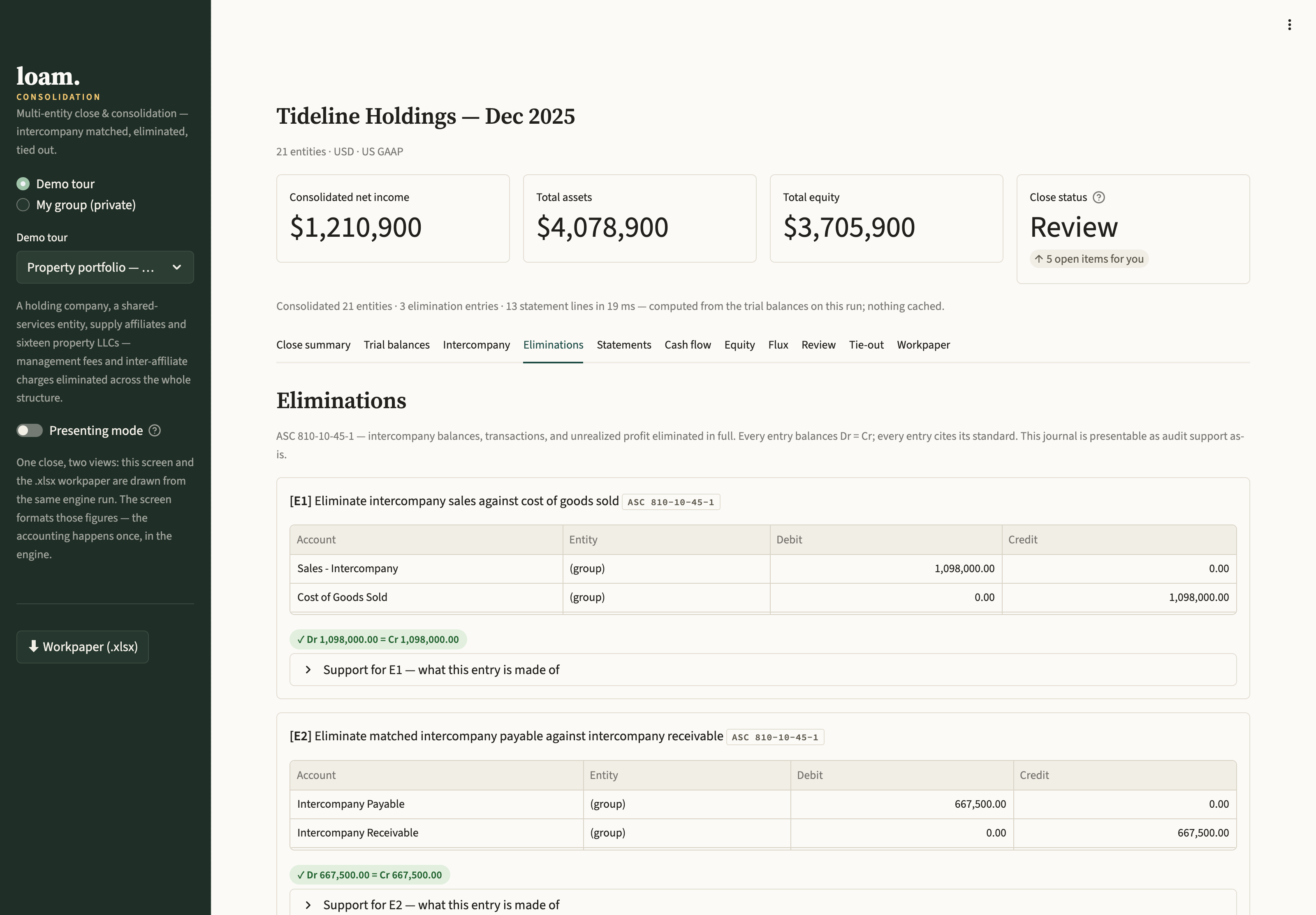
We don't ask you to trust it. We tie it.
Every consolidated line, matched against a known-good reference — your own system of record, or an independently prepared consolidation — and shown with its variance.
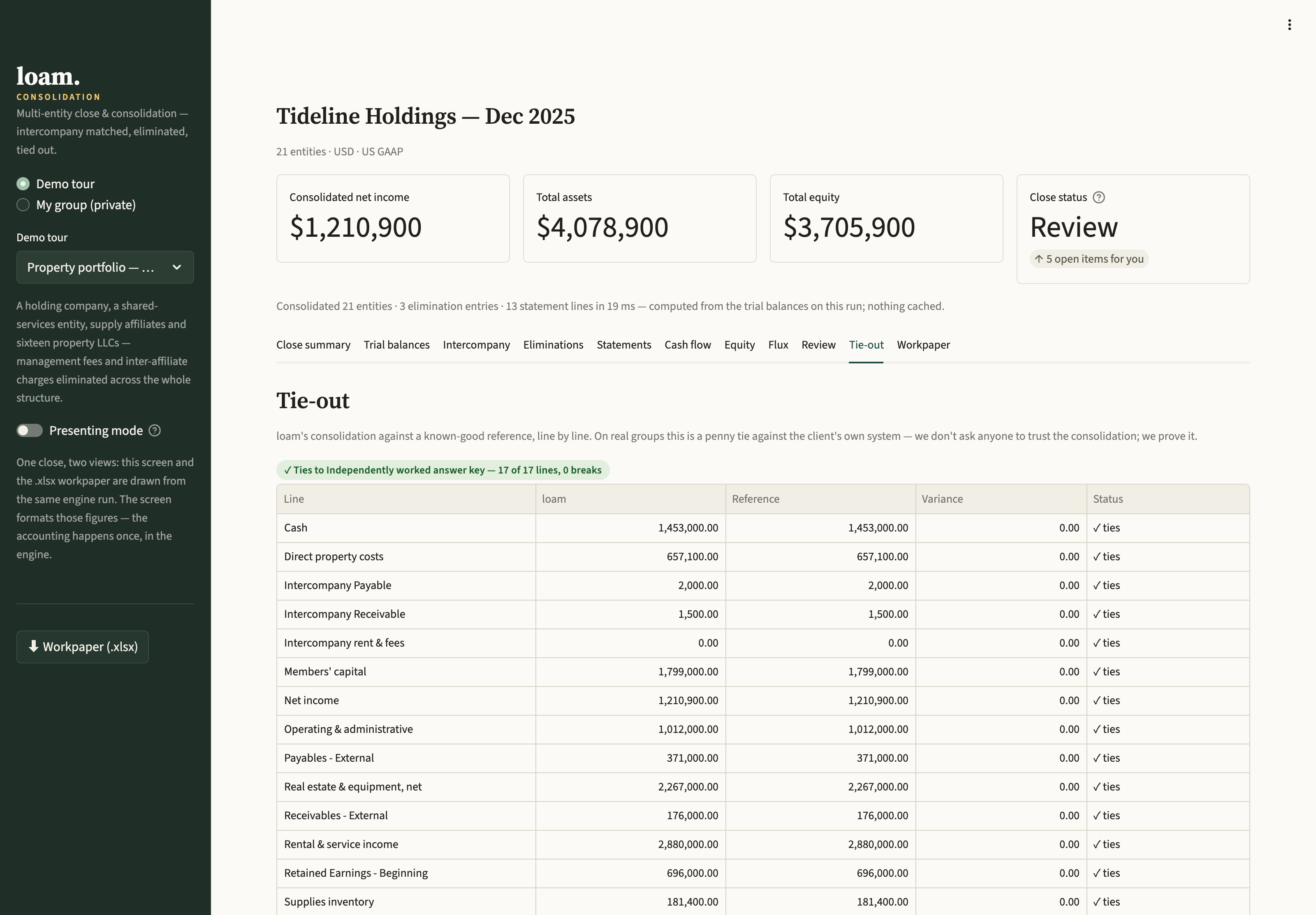
Tied out to what, if my current consolidation is the thing I don't trust?
To your existing combined report — and that's the point. Tying to it doesn't validate it. It produces a line-by-line reconciliation between what you have and what is correct, where every difference is explained by a cited elimination. No baseline at all? Prior-period audited financials or the lender package work too — and where there's genuinely nothing to tie to, loam says so on the face of the statement rather than skipping the check quietly.
Even a statement that ties is not automatically right.
Two entities disagree by a thousand dollars. Most tools bury it in a plug and show you a clean close. loam refuses.
It shows the difference, names what it needs, and will not call the close reconciled until you make the call. Every assumption it cannot independently validate is disclosed on the face of the statement — never absorbed into a number.
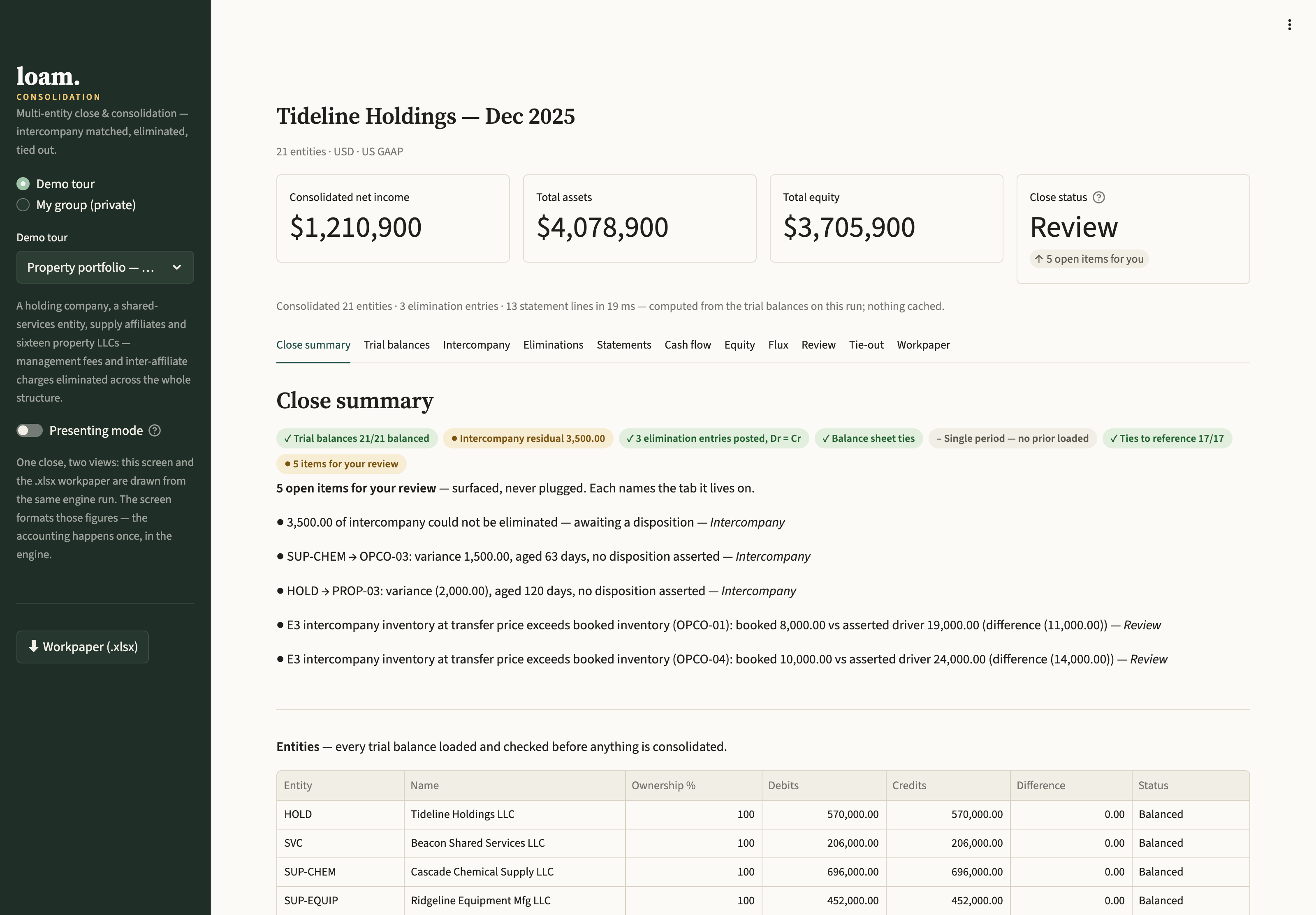
Every entry cites the standard.
Not a black-box adjustment. A journal — balanced, dated, and carrying its citation on the face.
Dr = Cr on every entry
No entry posts unless it balances. The check is the engine's, not a reviewer's.
ASC 810 / IFRS 10 cited
The applicable standard travels with the entry, under either basis.
Drill any figure to its support
Every number opens to the detail behind it, down to the driver rows.
The journal exports with its support intact — ready for auditor review.
A workpaper somebody signs.
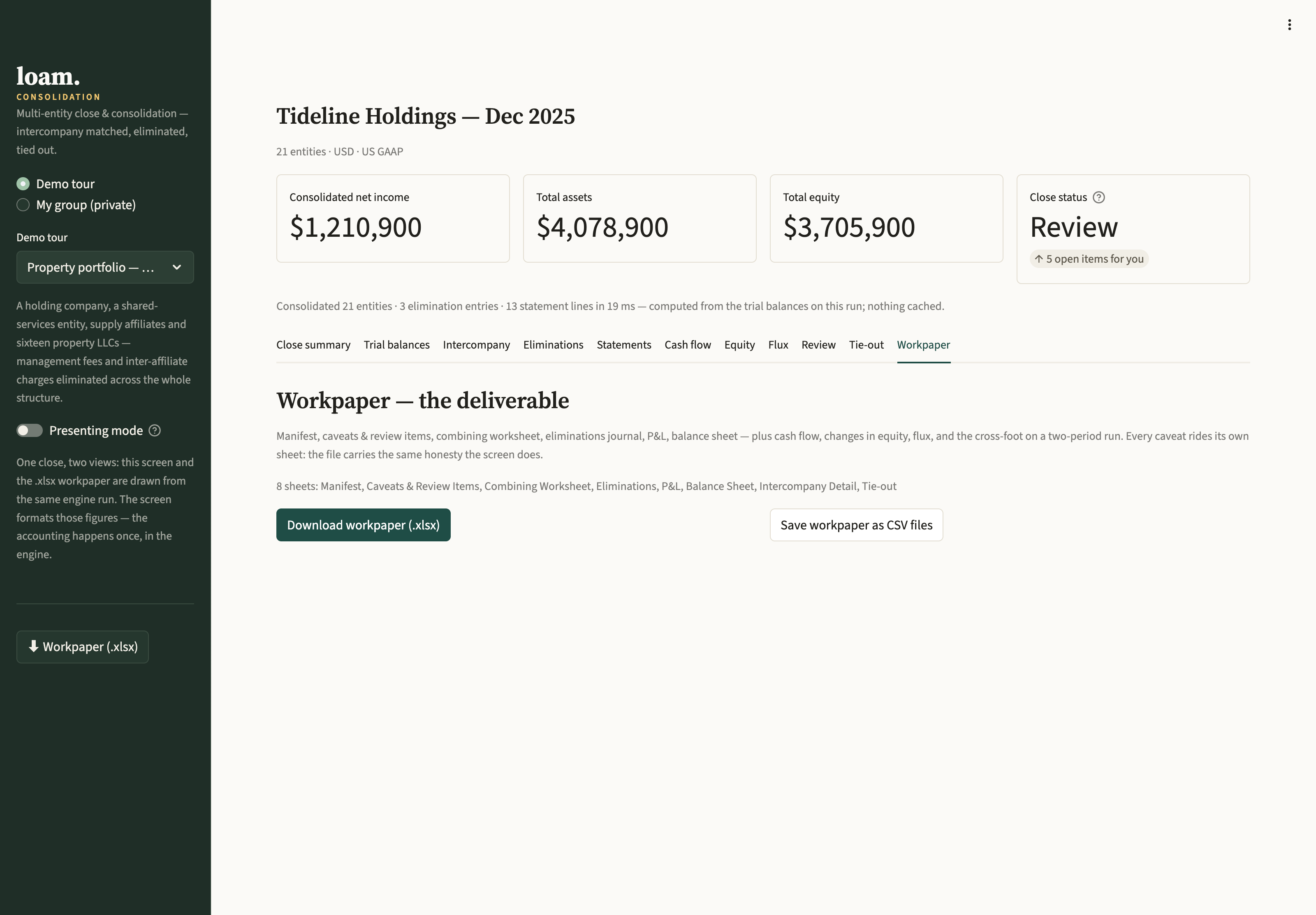
The full statement package on screen — and one Excel file carrying the combining worksheet, the elimination journal, the tie-out, and every caveat.
One sheet, end to end
Entity → combined → eliminations → consolidated.
Caveats travel with the file
Review items don't stay on a screen somebody forgot to check.
No re-keying
Once the mapping is set, next month is refresh and review.
One month, on your own books.
A pilot close against your trial balances — your entities, your chart of accounts, your intercompany. Not a sandbox, not sample data.
Consolidated statement package
Tied out line by line.
Elimination journal
Every entry cited to the standard.
Excel workpaper
Review-ready.
Every open item named
Nothing plugged.
Send one month of trial balances and the ownership percentages. That's enough to start.
What happens at 51 entities?
2–50 is the segment loam is built for, not a technical ceiling. If you're above it, say so and we'll tell you honestly whether it's a fit.